Showing posts with label 2007. Show all posts

Friday, March 23, 2007

Two One-man Shows - Cromoli Brothers & Bigger than Jesus

Rick Miller in Bigger Than Jesus [www.biggerthanj.com]
Photo: Beth Kates

In the past week I have seen two very different one-man shows, Theatre Skam's The Amazing and Impermeable Cromoli Brothers: The Best of the Cromoli Brothers and the Belfry Theatre's Bigger Than Jesus (a Wyrd Productions/Necessary Angel Theatre co-production). Seeing two solo shows so closely together leads me to consider the phenomenon of solo theatre, exemplified in Victoria's Uno Festival (from Intrepid Theatre).

Even though I have performed a one-woman play myself - Joan MacLeod's beautiful play Jewel - and therefore have deep empathy for those who undertake solo performances, I am not at heart a huge fan of solo theatre. For me, theatre is an essentially social art form, along with the other performing arts of dance and music, and what I am most interested in finding at the theatre are meaningful, well-written and well-performed dialogic encounters between characters. While there are some one-person shows that offer dialogue between characters - The Syringa Tree or I Am My Own Wife being good examples of this (although I feel the former to be a better play than the latter, perhaps because it features more inter-character dialogue) - most often a solo play offers one or more characters speaking directly or indirectly to themselves and/or to the audience. Dialogue is deferred in favour of monologue, or perhaps soliloquy. This is fine, and can be fine (as in Jewel, where a widow speaks in soliloquy to her dead husband throughout), but is arguably a far less social experience than that of theatre featuring two or more actors.

This is a philosophical position I am taking that values the inherent power of theatre to allow access to the privileged close observation of human interaction in all its facets; good, bad and ugly. This said, it takes a particularly strong monodrama to compare favorably in my view with a "regular" play.

Lucas Myers, one of the founders of Theatre SKAM, is a favorite actor of mine. Myers has a warm presence, great physicality and broad range that allows him to play drama and comedy with equal success. The Amazing and Impermeable Cromoli Brothers is one brother short as the show begins and St. John Cromoli has been stood-up by his brother Hasbro. But the show must go on, so we are treated to an interactive series of 15 songs and vignettes, the titles of which are posted on chart paper on stage. Audience members are invited by the flustered St. John, an old-school vaudevillian entertainer, to select the order in which they wish to see these pieces. Thus we are engaged in a wide range of "bits" presented with little more than what can be found in a battered red suitcase and accompanied on a ukelele. Myers' songs are sweet and often quite personal (he sings one about his brand new daughter), although they can sometimes contain a bit of a political bite. Some vignettes work better than others, some being little more than throwaway quick gags. My favorite was the cover of Bowie's "Major Tom" with a volunteer audience member playing a breath-powered keyboard (what is that thing called?) and a tiny stuffed Major Tom in a real tin can passed through the house as Myers sings, lit by a single light bulb. Fun and funny, but also quite lovely. The show is very slight, built around Myers' engaging personality; however, if you are a fan this is no bad thing.

Rick Miller and Daniel Brooks' Bigger Than Jesus is a different kettle of solo flying fish. A much more ambitious show, a multimedia piece incorporating ingenious use of live video, BTJ is a major award-winner [three 2004 Doras for play, performer and lighting design] with the positive reviews to match. Working loosely within the framework of the Catholic mass, Miller takes the audience through a part-lecture, part-monologue, part-diatribe, part-homage to the life and legacy of the Big JC Himself. Miller plays "himself" the actor, a Jewish academic, a James-Brownish preacher, a prayer-answering flight attendant, and, finally, Jesus. Woven thoughout are live video feeds from multiple directions in the theatre, sometimes manipulated by Miller himself, that give us backdrop images that are occasionally quite awesome in their power. The play is intelligent, highly theatrical (especially in the scene of the Last Supper as played by Miller in miniature with action figures including Star Wars characters, all projected via video onto the giant backdrop screen) and well-performed by Miller, who is clearly a multi-talented actor.

So why did it make such a small impression on me? I should have been the ideal audience member for this piece, lapsed Catholic that I am (Miller asked us to identify ourselves off the top of the show), but somehow the individual parts that seem very successful in the moment failed to add up to a sum that had an overall effect. Miller and Brooks' point, that Jesus the man and his ideals are very different from the legacy of Christianity and the ignorance and violence wrought in His name, seem a bit like preaching to the choir. Theatregoers tend to be an educated and sophisticated lot...don't we already know these things? What else can be said about the life of Jesus at this point in history and through the medium of theatre that moves us beyond the platitudes of Jesus Christ Superstar or Godspell? Yes, it is arresting to see Miller transform himself into Jesus, back turned at an altar with his face projected onto his vestment, but when he comes downstage to speak to the audience what we get are one-liners mixed in with the familiar Biblical wisdoms; "Love one another ... any questions?"

Beautiful images and skilful performance do not necessarily add up to great theatre. I received more soulful sustenance and real learning from Theatre Inconnu's recent low-budget production of Pinter's The Caretaker around how we human beings so often fail dismally to love one another, than in this highly-individualistic one-man show that failed to convince me of the essential human connection that Jesus tried so hard to reveal.

Thursday, December 28, 2006

Monday, November 27, 2006

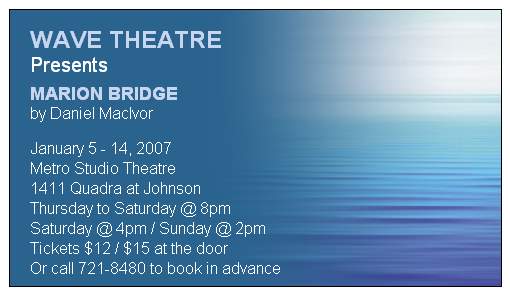
MARION BRIDGE Press Release


PRESS RELEASE
For Immediate Release


WAVE Theatre
[Workshop Actors of Victoria Ensemble]
Presents


MARION BRIDGE
by Daniel MacIvor


Co-directed and performed by:
Gina McIntosh
Monica Prendergast
Kate Rubin


January 5th to 14th, 2007
Metro Studio Theatre
1411 Quadra at Johnson
Thursday to Saturday - 8 pm
Saturday - 4 pm
Sunday - 2 pm
Preview January 4th – Pay What You Can
Tickets $12 / $15 at the door
or
Call 721-8480 to book in advance

SYNOPSIS:
MARION BRIDGE is the humorous and touching story of three sisters, two of whom return home to Sydney, Nova Scotia to help the third sister care for their dying mother. Trapped by life choices and unfulfilled expectations that have left them isolated, the three women search for the courage to create a new family from the remnants of the old. Marion Bridge was nominated for a Governor General's Award and was made into a feature film in 2002.

THE COMPANY
WAVE Theatre was formed as a cooperatively-run company in 2003 to create productions that showcase local Victoria actors and focus on mostly
contemporary Canadian theatre. To date, WAVE has successfully produced JEWEL by Joan McLeod, THE ATTIC, THE PEARLS AND THREE FINE GIRLS by Leah Cherniak, Anne-Marie MacDonald and Martha Ross (nominated for a 2004 Monday Magazine Outstanding Theatre production award), and a co-production with the Belfry Theatre, LION IN THE STREETS by Judith Thompson (as their annual Incubator project).

For more information on WAVE Theatre or this production of Marion Bridge, please contact Monica Prendergast at mprender@uvic.ca or 721-7997 x 2.

THE MARION BRIDGE ACTING ENSEMBLE


Gina McIntosh – Two-time winner of Monday's Outstanding Female Actor Award, Gina is a familiar presence onstage in Victoria. She has appeared in WAVE's previous productions of Lion in the Streets and The Attic, the Pearls and Three Fine Girls. Gina has also worked with Atomic Vaudeville as their irrepressible hostess Flora and in Qualities of Zero by Jacob Richmond, produced both at the Belfry and in Vancouver. At the Belfry, Gina played Miss Rose in last season's The Girl in the Goldfish Bowl. Gina can also be found at Langham Court Theatre or in various Fringe Theatre or Giggling Iguana productions. Gina teaches for Kaleidoscope Theatre School and often appears in their Christmas productions, as in this season's Charlotte's Web.

Monica Prendergast – The latest credit for Monica is the successful defense performance of her doctoral dissertation at UVic this year. When not teaching in the Departments of Theatre or Education at UVic, Monica has been seen on stage at the Phoenix Theatre, Langham Court Theatre and in all past WAVE Theatre productions. She also enjoys participating in Puente Theatre's WorldPlay readings and is currently co-developing a theatre-in-education project about peace activism with Puente's artistic director Lina De Guevara. Monica loves the process of collaboration and so is also pursuing a co-production with Victoria's ITSAZOO Productions of Alphonse by Wajdi Mouawad. She is thrilled to be back on stage with her two favorite actors in this production of Marion Bridge.

Kate Rubin – Kate is well-known to Victoria theatregoers for her performances with many companies including Kaleidoscope Theatre, Giggling Iguana Productions and, most recently, William Head on Stage's Macbeth. Kate has also appeared in the last two WAVE Theatre productions with Monica and Gina. For many years, her drama/theatre studio has been an invaluable place for young people and adults to find both training and community. Each spring her senior students present a full-length theatre production that is a vibrant showcase for young talent. This year, Kate has taken over the Belfry 101 audience education project at the Belfry (begun by Monica in 1999) and will be facilitating an original theatre production with these students during March Break.

Marion Bridge (from Canadian Theatre Encyclopedia)
Marion Bridge (Talonbooks 1999) by Daniel MacIvor is set in the kitchen of a family home in Nova Scotia. The family history is tracked in terms of the response of three daughters to their dying mother, who has made a deliberate choice to die on her own terms, leaving her daughters to assess the terms on which they are currently living. The eldest sister, Agnes MacKeigan, is an alcoholic, under-employed actress, who has reluctantly returned home. The middle sister, Theresa, is a nun, who has assumed the responsibility of caring for her mother and her younger sister, Louise, who is perceived as "strange" - a social misfit.
Marion Bridge begins with a monologue in which Agnes recounts a dream: she is drowning, and any hope of rescue by a young family sitting on the beach is denied. They misinterpret her frantic waving for help, and respond by waving back. Agnes's despair is related to her childlessness: she has given up a daughter for adoption. Her journey towards self-knowledge and an equilibrium informed by hope for the future are effected through her reconciliation with her mother and with her daughter.
Her plan to stay in the family home with her daughter and her sister Louise, is at first discouraged by Theresa, who is suspicious of her motives. Theresa also has her own private despair. Even though she belongs to a community of believers, and attempts to live out a Christian humanist philosophy, she experiences doubt and disbelief. She is sustained primarily through her contact with the land in the form of farming; her relationship to the earth is both visceral and spiritual.
As she tells Agnes, however, she no longer sees God in a world in which children are killing children, and "half the world [is] on drugs and the other half starving and people just letting it happen" (106). What she values is her connection to her mother --represented in the post-its passed from mother to daughter on which are scribbled indicators of her needs: "Mother's notes. They're so beautiful. At first just a bunch of marks and squiggles but once you understand it it's as big and wonderful as any language" (78). She respects her mother's wish to die alone, while the three sisters are visiting their estranged father and his new wife.
Although the play validates communication and connection, it also demonstrates the "beauty" of aloneness - the private individual worlds in which each woman lives. Louise's private world - her "reality" - is that of the soap operas on television. She finally enters a larger world when she reaches out to a woman friend, and buys a truck from her.
All three sisters finally make the long-delayed trip to Marion Bridge - which has been for their mother a family goal, and but which when realized in the past, has disappointed her daughters. This time, however, it is the joint excursion that is the point, rather than the arrival. Once on the bridge - a connecting point between past, present, and future, they celebrate their mother's life and death by scattering the post-its "high into the air" like confetti (127).
Marion Bridge was nominated for a Governor General's Award. It was filmed in 2002, with screen play by MacIvor, and direction by Camelia Frieberg.
Review by Anne Nothof
http://www.canadiantheatre.com/dict.pl?term=Marion%20Bridge